3rd Grade Habitat Hunt

In this science unit on habitats students will be able to demonstrate their reading comprehension skills, including reading strategies, inference, literal meaning, and critical analysis.
Step #1 Read the definition below
What is a habitat?
The area where a plant or animal lives is called its habitat.
There are many different types of habitats.
We will be looking at: desert,grasslands, ocean, tropical rainforests, tundra and the coral reef.
Click the Links below for an interactive overview
 Habitats_Hitchams
Plants and Animals_BNSC
Step#2 Taking Notes
What are some things we want to learn about in each habitat?
Click on the link below to open up a sheet you can take notes on!
Habitat Hunt.doc

Watch the video above to see what each habitat looks like!
 has sound

Click above to put animals in their habitats
|
What Kind of Animal is This?
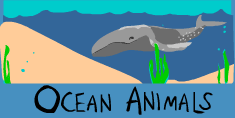
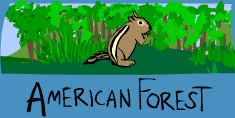
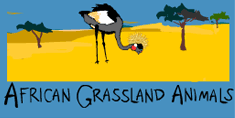
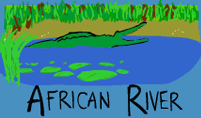
| In these games , kids need to be able to tell the difference between mammals, reptiles, birds, fish, amphibians, and other kinds of animals. Each game is full of animations, sounds, and fun! |
|
 |
 |
|
|
Features: Fish, Mammal, Bird, Crustacean, Mollusk, Reptile
|
Features: Mammal, Reptile,
Amphibian, Insect, Bird
|
 |
 |
 |
|
Features: Mammal, Bird,
Reptile, Insect
|
Features: Mammal, Bird,
Reptile, Insect, Arachnid, Fish
|
Features: Mammal, Bird,
Amphibian, Reptile, Insect
|
|
Have feedback? Have an idea or suggestion for the Kid's Corner? We'd love to hear it. Email us! |
Also try:
 |
 For help with the different kids of animals, visit our animal pages for illustrated and fun ways to learn about mammals, birds, reptiles, amphibians and fish! For help with the different kids of animals, visit our animal pages for illustrated and fun ways to learn about mammals, birds, reptiles, amphibians and fish!
|
|
|
|
Create an Animal Forest |
Animal Forest Movie |
Create a Jungle |

Animal Jungle Game
|
|
|
|
|
 |

Animal Safari
Match the names of these animals to their pictures.

Zoo Crew
Find out what different groups of animals are called in this vocabulary game.

Animal Tracks
Match the footprints to the animals that make them.
Kids can answer questions about the world's famous mountains, deserts and oceans in this geography game. read more

Jump, splash, and play as a dolphin in this arcade-style game. read more

Help these critters find their natural habitats in Animal Homes. read more
Research
Under each of the habitats you will find websites that will help you answer the questions on your sheet!
Click on the icon below to open up your worksheet'.
Go to each website. Copy and paste the answers under the questions!
Habitats_Hitchams
Plants and Animals_BNSC
 Save your work on your Home drive or in your Folder
Desert

 Computer resource tools
http://www.ucmp.berkeley.edu/exhibits/biomes/deserts.php temperatures.
http://members.aol.com/QuestSite/1/2.html
http://www.desertusa.com/may96/du_sand.html
http://www.desertusa.com/du_plantsurv.html desert plants
http://www.cvwd.org/archive/lush&eff/ desert plants
http://www.woodlands-junior.kent.sch.uk/Homework/habitats.html#desert
http://www.defenders.org/wildlife_and_habitat/habitat/desert.php
http://www.enchantedlearning.com/biomes/desert/desert.shtml desert animals
Forest

http://nationalzoo.si.edu/education/conservationcentral/walk/walk1_broadband.html
http://www.ucmp.berkeley.edu/exhibits/biomes/forests.php
http://www.nature.org/initiatives/forests/
http://www.hamiltonnature.org/habitats/forest/forest.htm
http://inchinapinch.com/hab_pgs/terres/d_forest/td_forest.htm
Grasslands

Computer resource tools
http://www.woodlands-junior.kent.sch.uk/Homework/habitats.html#grassland
http://www.defenders.org/wildlife_and_habitat/habitat/grasslands.php
http://www.bbc.co.uk/nature/animals/wildbritain/habitats/grassland/
http://www.enchantedlearning.com/biomes/grassland/grassland.shtml Grassland animals with Printouts
http://www.mbgnet.net/sets/grasslnd/index.htm
Ocean
Computer resource tools
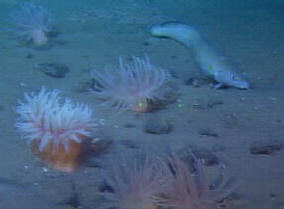
http://www.enchantedlearning.com/coloring/oceanlife.shtml ocean animlas
http://www.mbgnet.net/salt/oceans/index.htm
http://www.mbgnet.net/salt/coral/indexfr.htm
http://www.vtaide.com/png/oceanweb2.htm
Tropical RainForest

Computer resource tools
http://library.thinkquest.org/17456/
http://www.enchantedlearning.com/subjects/rainforest/animals/Rfbiomeanimals.shtml good info pictures of plants and animals
http://www.mbgnet.net/sets/rforest/index.htm
picture game
http://images.google.com/imgres?imgurl=http://members.aol.com/adrmoser/HabitatsTN.gif&imgrefurl=http://members.aol.com/adrmoser/AvenuesAUnit6.html&h=448&w=849&sz=179&hl=en&start=11&tbnid=aX9g3aPo45pI0M:&tbnh=77&tbnw=145&prev=/images%3Fq%3Dhabitats%26gbv%3D2%26svnum%3D10%26hl%3Den
Ponds

Computer resource tools
http://42explore.com/pond.htm
http://www.enchantedlearning.com/biomes/pond/pondlife.shtml
http://www.hitchams.suffolk.sch.uk/habitats/pond.htm
http://www.ypte.org.uk/docs/factsheets/env_facts/ponds.html
http://www.naturegrid.org.uk/pondexplorer/pond-cross.html
Tundra

Computer resource tools
http://www.woodlands-junior.kent.sch.uk/Homework/habitats.html#artic
http://www.ucmp.berkeley.edu/exhibits/biomes/tundra.php
http://www.mbgnet.net/sets/tundra/index.htm
http://42explore.com/polar.htm
http://windaroo.haasta.com/tundra.php
Coral Reef

Computer resource tools
http://www.tqnyc.org/NYC063662/habitat.html
http://www.enchantedlearning.com/biomes/coralreef/coralreef.shtml
http://www.mbgnet.net/salt/coral/indexfr.htm
http://www.nceas.ucsb.edu/nceas-web/kids/biomes/coral.htm
http://www.seaworld.org/infobooks/Coral/habdiscr.html
 Interactive learning activities
Great Habitat Match Up
Magic School Bus
http://www.scholastic.com/magicschoolbus/games/habitat/habitat.htm
Interactive Food Chains


The order that animals feed on other plants and animals is called a food chain.
Do you think you can put a food chain together?
Click below to give it a try and learn why every animal within a food chain is so important.
Interactive learning activities
Practice quiz to help you study
Food Chains and Food Web Quiz
Meaning of Words
Herbivore - an animal that eats plants. Carnivore - an animal that eats other animals. Omnivore - an animal that eats both plants and animals eg bears and humans.
Producer - usually a green plant that produces its own food by photosynthesis Primary Consumer - Animals that consume only plant matter. They are herbivores - eg rabbits, caterpillars, cows, sheep, and deer.Secondary Consumer - Animals that eat primary consumers (herbivores). Tertiary Consumer - Animals that eat secondary consumers ie carnivores that feed on other carnivores.
Predators - kill for food. They are either secondary or tertiary consumers - eg polar bears, golden eagles Prey - are the organisms that predators feed on. Examples of predator and prey species are: fox and rabbit; blue tit and caterpillar; wolf and lamb
Scavenger - a consumer that eats dead animals (e.g. crab, crow, vulture, buzzard and hyena. ) Detritivore - a consumer that obtains its nutrients from detritus Decomposer - an organism such as bacteria and fungi that breaks down dead organisms and their wastes. . (They do not 'eat' the food like scavengers, as they have no mouth-parts. Instead they break down solid matter into liquids which they can absorb.) Examples: bacteria and some fungi. Trophic Level - A trophic level is each level in a food chain. Matter is always 'lost' as heat energy at each trophic level. Basal Energy Requirement (B.E.R.) - the amount of energy used by an organism's body just to keep alive, when no food is being digested and no muscular work is being done.
Projects
Pick one
1. Create a shoe box habitat (biome)
2. Use Photostory to import pictures of your habitat
3. Create a list of animals and plants in your habitat
4. Create a rap or song for your habitat



Comments (0)
You don't have permission to comment on this page.